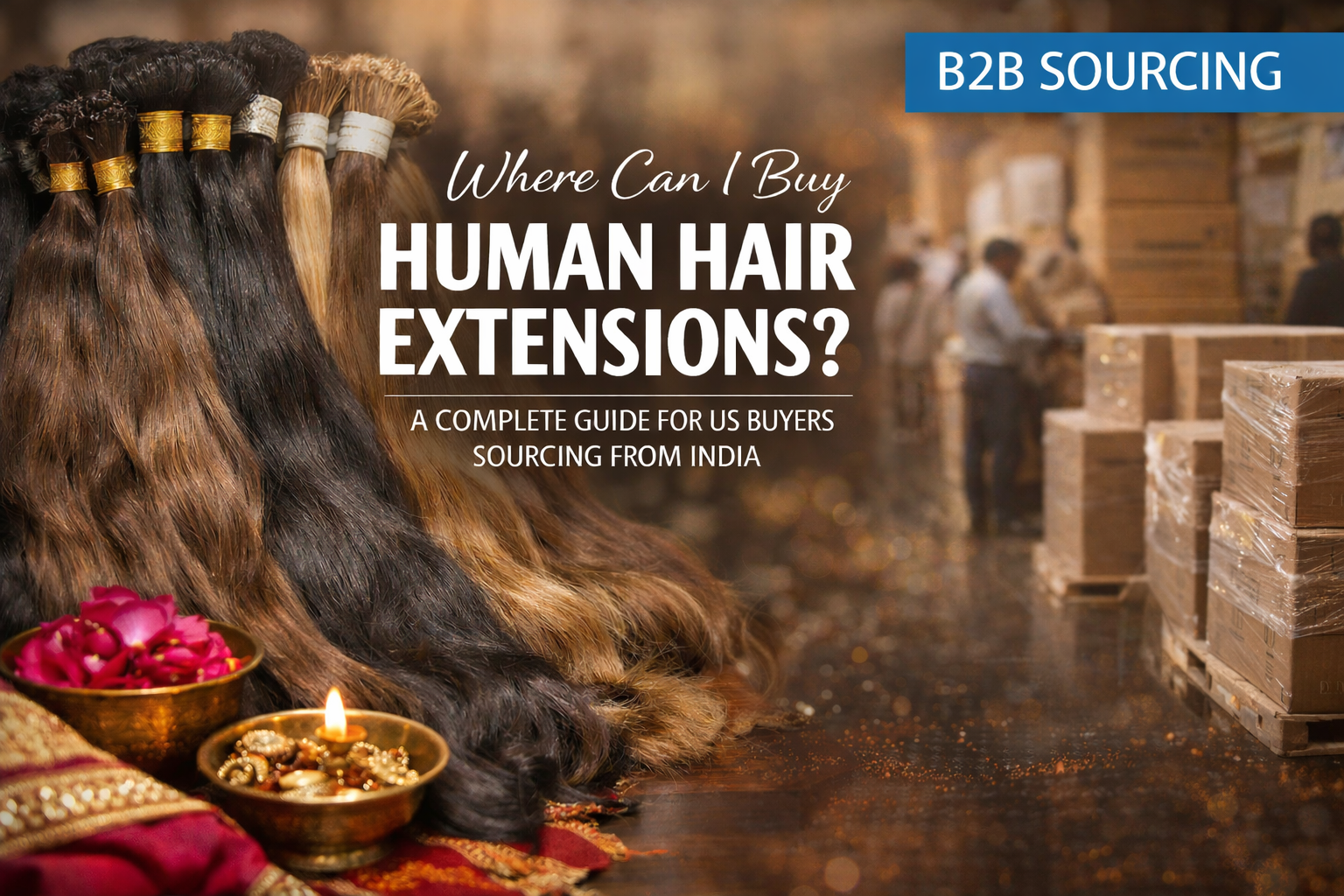
Where Can I Buy Human Hair Extensions?
Finding a reliable source for human hair extensions can be difficult, especially when you are buying for a salon, beauty brand, or wholesale business. Product photographs may look impressive, but they do not always tell you how the hair will perform after washing, styling, or repeated use. For this reason, working with reputable raw Indian human hair vendors in India can help buyers evaluate hair quality, sourcing practices, consistency, and suitability before placing larger wholesale orders.
For US buyers, India has become an important sourcing market for human hair extensions. Indian suppliers offer a wide range of products, including weft hair, machine weft hair, raw hair, and different natural textures. However, choosing the right supplier requires more than comparing prices.
The quality of the hair, sourcing practices, sample availability, communication, packaging, customization options, and shipping experience can all affect your final buying decision. Understanding these factors before placing a bulk order can help you avoid unreliable suppliers and build a stronger long-term supply relationship.
Why Do US Buyers Source Human Hair Extensions from India?
India has a long-established hair collection, processing, and export industry. One important source of Indian human hair is temple hair, where people voluntarily donate their hair as part of religious practices. Depending on how the hair is collected and processed, it can provide useful raw material for different extension products. Businesses looking for consistent sourcing can compare reputable raw Indian human hair suppliers in India based on hair quality, sourcing practices, processing standards, and product consistency.
Indian hair is also available in a variety of natural textures, making it suitable for different customer preferences. Straight, wavy, and other textures can be used to create products for salons, retailers, and direct-to-consumer brands.
Another advantage is the availability of manufacturers and exporters that work with international customers. Some suppliers offer wholesale orders, custom packaging, private labeling, and product specifications based on a brand's requirements.
However, the fact that a supplier operates from India does not automatically guarantee quality. Buyers should still evaluate individual suppliers carefully and test products before committing to a large shipment.
What Types of Human Hair Extensions Can You Buy?
Before contacting a supplier, it helps to understand the type of extension you actually need. Different products are designed for different applications and customers. Once you know your requirements, you can compare raw Indian human hair manufacturers in India based on product quality, customization options, processing standards, and their ability to meet wholesale requirements.
Weft Hair Extensions
Weft hair extensions consist of strands secured together along the top to form a continuous track. They are commonly used for sew-in installations and can also be packaged as bundles for retail customers.
For businesses, wefts can be a practical product because they are relatively straightforward to package and offer customers flexibility in styling and installation.
Machine Weft Hair Extensions
Machine weft hair is produced using stitching equipment that secures the hair along the weft. The finished seam can provide a firm structure that works well for sew-in applications. When sourcing this type of product, businesses can compare raw Indian hair suppliers in India based on hair quality, weft construction, consistency, and wholesale requirements.
Machine wefts are also commonly considered by businesses that need consistent production for larger orders. One example is machine weft wavy raw hair, which combines a naturally wavy texture with a machine-made weft structure.
Raw Human Hair
Raw hair generally refers to hair that has not undergone chemical processing to significantly change its natural characteristics. Buyers should be careful with this terminology because suppliers may use the word differently. To ensure better transparency about sourcing and processing, buyers can Buy Raw Indian Human Hair Directly from India from suppliers who clearly explain the hair’s origin and processing methods.
If raw hair is important to your brand, ask the supplier about the collection method, processing history, chemical treatments, and whether the hair has been coated with products that temporarily increase softness or shine.
The safest approach is to request a sample and evaluate it yourself before placing a substantial order.
How Can You Check Human Hair Quality Before Buying?
Product descriptions alone are not enough to judge hair quality. A sample gives you a much better indication of how the product will behave.
Start by checking the overall texture and movement of the hair. Run your fingers through it and look for excessive tangling or unusual roughness. You should also examine the weft construction, stitching, shedding, and consistency from root to tip.
Pay attention to how the hair responds after washing. Some hair can appear exceptionally soft when it has been treated with silicone-based coatings or conditioning products. That initial appearance may change after several washes.
If you are buying for resale, test the sample under conditions similar to those your customers will use. A supplier that is willing to discuss product specifications openly and provide samples is generally easier to evaluate than one that avoids detailed questions.
Where Can US Buyers Find Indian Hair Suppliers?
There are several ways to find Indian human hair suppliers.
Some businesses visit manufacturers or exporters directly in India. This can be useful when placing larger orders because buyers can inspect facilities, discuss specifications, and establish direct communication. Visiting or communicating with established Indian human hair vendors can also help buyers assess product quality, sourcing practices, customization options, and production capabilities before committing to a bulk order.
International beauty and hair trade shows are another option. These events allow buyers to meet multiple suppliers and compare products in person.
Online sourcing has also become common. Many Indian manufacturers and exporters maintain websites where international buyers can review product categories and contact sales teams.
Regardless of how you find a supplier, avoid making a large purchase simply because a website looks professional. Check product samples, business communication, export experience, customer references where available, and the supplier's ability to meet your specific requirements.
What Should You Ask a Hair Supplier Before Placing an Order?
A short conversation with a supplier can reveal a lot about how they operate.
Ask where the hair is sourced, how it is processed, what textures and lengths are available, and whether the product is raw or processed. If you require a particular construction, such as machine weft hair, confirm the specifications before ordering.
You should also discuss minimum order quantities, sample costs, production timelines, packaging, private labeling, payment terms, and shipping arrangements.
If you operate a US hair brand, ask whether the supplier regularly exports to the United States. Familiarity with international shipping procedures can make the ordering process easier.
Clear answers matter. A supplier does not need to promise perfection, but they should be able to explain their products and processes without avoiding reasonable questions.
Why Samples Matter Before Wholesale Orders
Ordering samples may seem like an additional expense, but it can prevent much larger problems later.
A sample allows you to compare suppliers based on actual product quality rather than photographs or marketing descriptions. You can examine texture, density, stitching, shedding, tangling, and how the hair responds to washing and styling.
For a growing hair business, testing samples from several suppliers can also help establish your own quality standards. You may discover that one supplier offers better texture while another provides stronger weft construction or more suitable packaging.
Once you identify a supplier that meets your expectations, you can move toward a larger order with greater confidence.
Private Label and Custom Packaging Options
Many hair brands want their products to look like their own rather than arriving in generic packaging. If this is important to your business, ask suppliers whether they provide private-label or custom packaging services.
Custom packaging can include branded boxes, bags, labels, tags, and other presentation materials depending on the supplier's capabilities.
Discuss these requirements before placing an order because customization may affect minimum quantities, production time, packaging costs, and artwork requirements.
For new brands, it is often sensible to confirm the hair quality first and then invest more heavily in customized packaging once the supplier relationship has been tested.
Shipping Human Hair from India to the United States
International shipping is another important part of the sourcing process. Delivery time can depend on the courier, destination, shipment size, customs procedures, and the documentation associated with the order.
Some exporters use major international courier services for smaller shipments, while larger commercial orders may require different logistics arrangements.
Before ordering, ask the supplier which shipping method will be used, whether tracking is provided, what documents accompany the shipment, and whether customs-related charges may apply.
Starting with a smaller shipment can be a practical way to evaluate both product quality and shipping reliability before moving to larger wholesale orders.
How to Choose the Right Indian Hair Supplier
The cheapest supplier is not necessarily the best supplier. For a business, consistency is often more valuable than a low initial price.
Look for suppliers that provide clear product information, offer samples, understand your specifications, communicate professionally, and have experience working with international customers.
You should also consider whether the supplier can maintain consistent quality as your order volume grows. A product that performs well in one sample but changes significantly from one batch to another can create problems for your customers.
A strong supplier relationship develops over time. Start with testing, communicate your requirements clearly, monitor the first few orders, and document the product specifications that meet your expectations.
So, Where Can You Buy Human Hair Extensions?
For US businesses looking for human hair extensions, India can be a valuable sourcing destination, particularly when you need access to different textures, weft constructions, wholesale options, or customized products.
The most important step is not simply finding a supplier. It is finding a supplier whose product quality, communication, production capabilities, and shipping process match your business requirements.
Request samples before placing a large order, ask detailed questions, compare several suppliers, and test the hair under real-use conditions. Taking this extra time at the beginning can help you build a reliable supply chain and deliver better products to your customers.
Whether you need weft hair extensions, machine weft hair, raw hair, or customized wholesale products, careful supplier evaluation is the foundation of a successful sourcing relationship.
Frequently Asked Questions
1. Where can I buy human hair extensions for my US hair business?
US hair businesses can source human hair extensions from Indian manufacturers, exporters, wholesalers, and international trade suppliers. Before purchasing, compare samples, product specifications, pricing, minimum order quantities, customization options, and shipping arrangements.
2. Why do US hair brands source human hair from India?
India has an established human hair industry with access to naturally sourced hair and experienced manufacturers and exporters. Buyers can find different textures, weft constructions, wholesale products, and private-label options depending on the supplier.
3. How can I verify the quality of human hair extensions?
Request samples before placing a bulk order and examine texture, shedding, tangling, stitching, density, and overall construction. Washing and styling the sample can also reveal how the hair performs beyond its initial appearance.
4. What is the difference between raw hair and processed hair?
Raw hair generally refers to hair that has not been chemically altered to significantly change its natural characteristics. Processed hair may undergo treatments such as coloring, texturizing, or other processing, so buyers should confirm the exact processing history with the supplier.
5. Can Indian hair suppliers provide private-label packaging?
Some Indian hair manufacturers and exporters offer private-label services, including branded packaging and labels. Requirements vary between suppliers, so buyers should confirm available customization options, minimum quantities, additional costs, and production timelines before ordering.
6. How should I choose a reliable human hair supplier in India?
Compare samples from multiple suppliers and evaluate product quality, communication, export experience, pricing, minimum order requirements, customization capabilities, and shipping processes. Starting with a smaller order can help you assess reliability before committing to larger volumes.




.jpg)

 (2).jpg)
.jpg)


