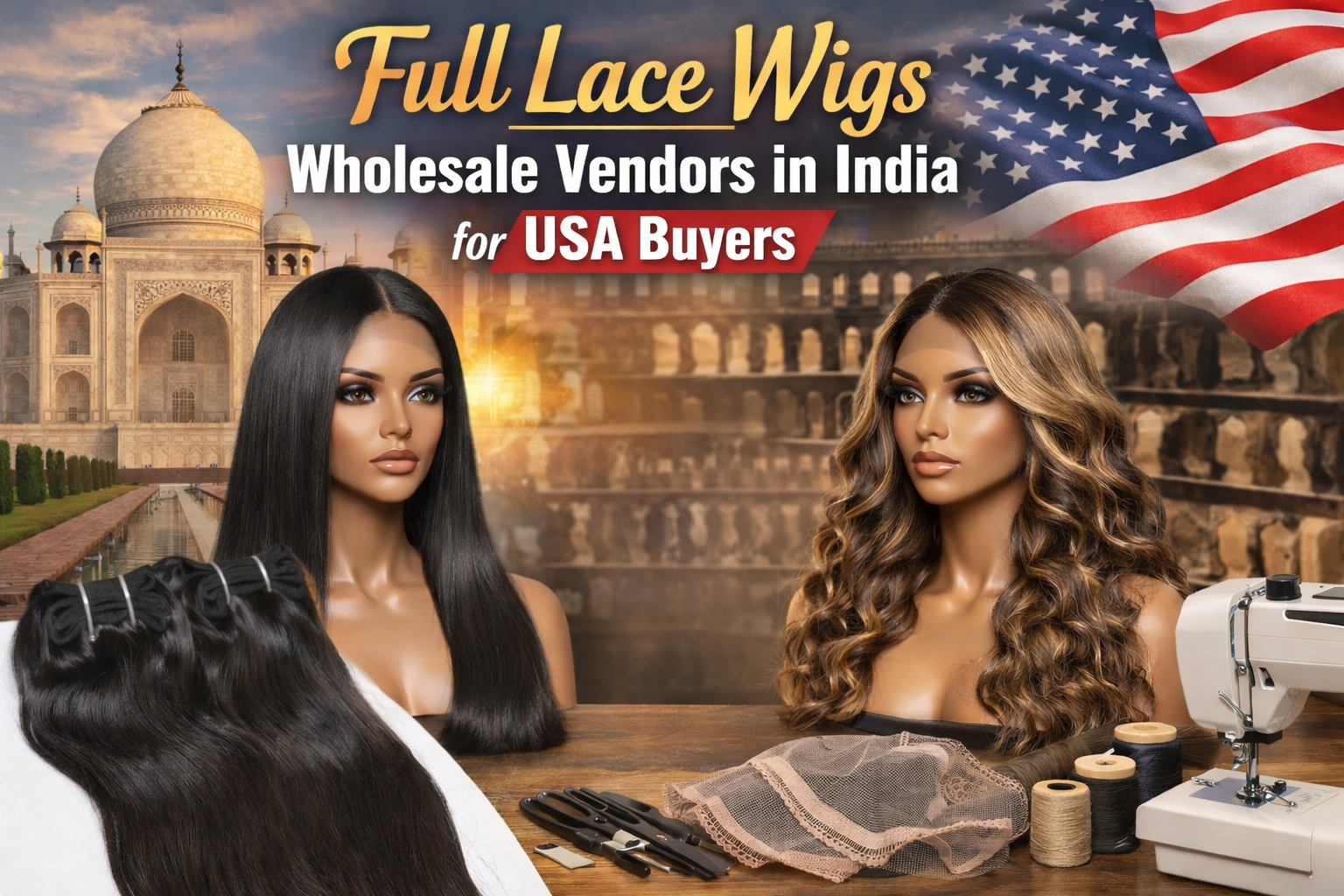


How to Find Reliable Wholesale Hair Extension Manufacturers for USA Businesses
.jpg)
Finding the right wholesale hair extension manufacturer is an important decision for US salons, beauty retailers, online hair brands, and private-label businesses. The supplier you choose can affect product quality, customer satisfaction, pricing, delivery times, and the long-term reputation of your brand.
However, comparing manufacturers only by price can lead to expensive mistakes. A reliable supplier should be able to provide consistent product quality, clear specifications, suitable minimum order quantities, dependable production, customization options, and transparent communication.
For USA businesses sourcing from overseas, there are also additional factors to consider, including international shipping, packaging, documentation, lead times, and the manufacturer's experience with export orders.
This guide explains what to check before choosing a wholesale hair extension manufacturer and how to compare potential suppliers more effectively.
Before contacting manufacturers, clearly define what your business actually needs.
Your requirements may include:
Hair extension type
Hair origin
Hair length
Texture
Color
Weight per pack
Attachment method
Product packaging
Monthly order volume
Target selling price
Private-label requirements
For example, a salon may need a smaller selection of professional-grade extensions, while an online hair brand may require multiple lengths, colors, textures, and consistent stock throughout the year.
Having these details ready makes it easier to compare manufacturers on the same basis.
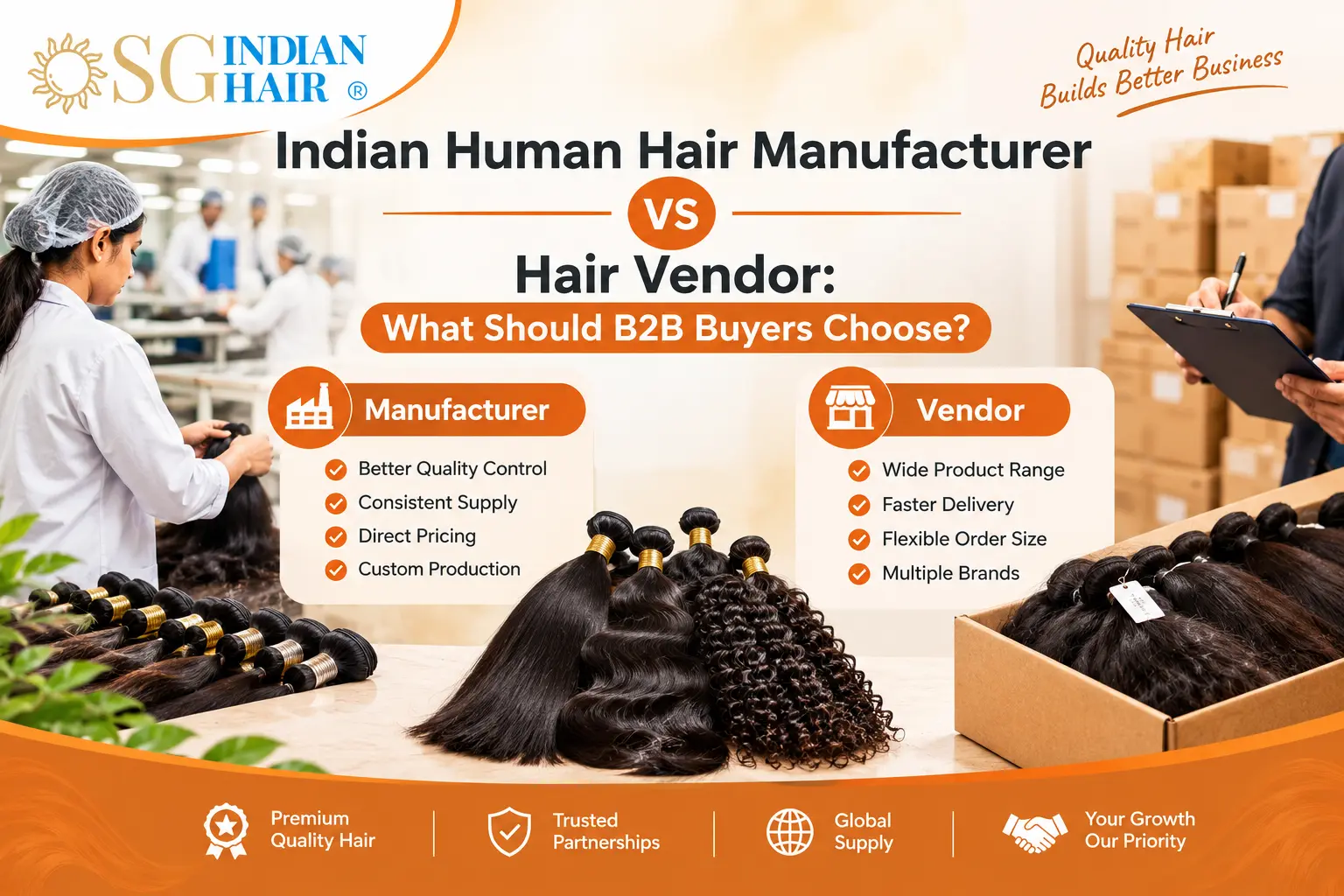
One of the first things a buyer should determine is whether a company actually manufactures its products or simply resells hair purchased from another supplier.
This distinction can matter when you need consistent quality, product customization, bulk production, or private labeling.
Ask potential suppliers:
Where is the production facility located?
Which products are manufactured in-house?
What stages of production are handled by the company?
Can they provide photographs or videos of the facility?
What is their normal production capacity?
Can they explain their quality-control process?
A manufacturer that can clearly explain its production process is generally easier to evaluate than a supplier that only provides product photos and prices.
Never judge a wholesale hair supplier only from photographs.
Request samples before committing to a large order. The sample gives you an opportunity to evaluate the actual product and compare different suppliers under similar conditions.
When inspecting a sample, check:
The hair should have the characteristics promised in the product specification. Check whether the texture remains consistent after washing and normal handling.
Brush and handle the sample to observe whether excessive shedding occurs.
Test the hair from root to tip and observe how easily it tangles during handling.
If your business is specifically looking for Indian hair, compare sourcing practices, processing methods, hair quality, and supplier transparency before choosing from the best raw Indian human hair vendors in India.
For finished extensions, inspect the attachment, weft, tape, clips, bonds, or other construction elements depending on the product.
Look for uneven lengths, excessive short strands, visible defects, or inconsistencies between samples.
A sample should be treated as a quality-control step rather than simply a demonstration of what the supplier sells.
Hair sourcing can directly affect the characteristics and consistency of the final product.
A serious wholesale buyer should ask the manufacturer where the hair comes from and how it is collected, sorted, cleaned, processed, and prepared.
Useful questions include:
What is the source of the hair?
How is the hair sorted?
How is it cleaned and sanitized?
What processing is performed?
Is the hair chemically treated?
How is consistency maintained between batches?
If your business is specifically looking for Indian hair, compare sourcing practices, processing methods, hair quality, and supplier transparency before choosing from the best raw Indian human hair vendors in India.
Do not rely only on marketing terminology. Ask for product specifications and evaluate samples yourself.
A reliable manufacturer should have a repeatable process for checking products before shipment.
Quality control may involve checking:
Hair length
Weight
Texture
Color
Shedding
Tangling
Attachment strength
Product dimensions
Packaging
Order quantity
For a growing US brand, consistency between one order and the next can be just as important as the quality of the first sample.
A manufacturer that produces an excellent sample but cannot maintain the same standard across bulk orders may create problems for your business.
Minimum order quantity, or MOQ, is another important factor when comparing wholesale hair extension manufacturers.
Do not automatically choose the supplier with the lowest quoted price.
Instead, compare the complete offer.
Consider:
Price per unit
MOQ
Sample cost
Packaging cost
Custom labeling cost
Color customization
Shipping charges
Production lead time
Payment terms
Replacement or quality-issue policies
A supplier with a slightly higher unit price may provide better consistency, packaging, communication, and production reliability.
The goal is not simply to find the cheapest hair. The goal is to find a supplier that gives your business a sustainable balance between quality and cost.
Your supplier should be capable of supporting your expected order volume.
Ask about normal production lead times and what happens when order volumes increase.
Important questions include:
What is the normal production time?
How much can the factory produce each month?
Can production increase during busy periods?
How are urgent orders handled?
How far in advance should repeat orders be placed?
How is inventory managed?
This becomes particularly important when your business is growing. A supplier that can handle a small trial order may not necessarily have the capacity required for regular wholesale production.
If you are building your own hair brand, customization can be an important part of supplier selection.
Depending on the manufacturer, customization may include:
Custom packaging
Brand labels
Product tags
Custom colors
Different lengths
Different weights
Customized product combinations
Private-label presentation
Before agreeing to customization, ask for clear specifications and samples of the final packaging or product.
It is also useful to confirm whether customization requires a separate MOQ and whether additional production time will be required.
For USA buyers working with an overseas manufacturer, export experience can simplify the purchasing process.
Ask whether the supplier regularly handles international wholesale orders and whether they can provide clear information about shipping methods, documentation, packaging, and estimated transit times.
You should also confirm:
Shipping method
Shipping responsibility
Estimated transit time
Tracking availability
Packaging standards
Required commercial documents
How damaged or missing shipments are handled
Do not assume that every manufacturer has the same export process.
Communication problems can become expensive when you are managing an international supply chain.
During your initial conversations, pay attention to how clearly the manufacturer responds.
A good supplier should be able to explain:
Product specifications
Pricing
MOQ
Sample availability
Production timelines
Customization
Shipping arrangements
Payment requirements
Be cautious if important questions are repeatedly ignored or if product specifications change during discussions.
Clear communication before the first order can give you a better idea of how the supplier may handle future orders.
US buyers can compare the best raw Indian human hair suppliers in India based on product quality, MOQ, pricing, manufacturing capacity, customization options, and export support.
Depending on your business model, you may need different products and sourcing options. Comparing the best Indian human hair vendors can help businesses evaluate product variety, quality, pricing, and suitability for their target customers.
It is better to compare several potential manufacturers using the same evaluation criteria.
For example, create a simple supplier comparison sheet:
This makes the decision more objective.
A supplier should not be selected because of one attractive factor. Look at the complete picture.
There are several reasons to slow down before placing a large wholesale order.
Be careful when a supplier:
Refuses to provide samples
Cannot explain product specifications
Gives inconsistent information
Offers unusually low prices without explaining why
Avoids questions about sourcing
Cannot provide clear production information
Changes MOQ or pricing unexpectedly
Provides poor communication
Makes claims that cannot be verified
One warning sign does not automatically mean that a supplier is unreliable. However, several warning signs together should encourage further investigation.
Before selecting a supplier, make sure you can answer these questions:
Product
What exact type of hair extension am I buying?
Quality
Have I tested a physical sample?
Sourcing
Can the manufacturer clearly explain its hair sourcing and processing?
Manufacturing
Does the company have the production capability required for my order volume?
MOQ
Does the minimum order fit my current business size?
Pricing
Have I compared the complete landed cost rather than only the unit price?
Customization
Can the manufacturer provide my required packaging and branding?
Shipping
Does the supplier have a clear process for shipping wholesale orders to the USA?
Consistency
Can the manufacturer maintain quality across repeat orders?
Communication
Can the supplier answer technical and commercial questions clearly?
If the answers are satisfactory, you have a much stronger basis for moving forward with a wholesale partnership.
For a US hair business, the manufacturer is more than a source of inventory. Product consistency affects customer reviews, repeat purchases, returns, brand reputation, and overall profitability.
A reliable manufacturer can also make it easier to expand your product range as your business grows.
For this reason, the best approach is to evaluate suppliers carefully before placing a large order. Compare samples, specifications, pricing, production capabilities, customization, and communication rather than making the decision based on price alone.
Finding reliable wholesale hair extension manufacturers for USA businesses requires more than a quick online search.
Start by defining your product requirements, identify manufacturers that can meet those requirements, request samples, evaluate quality, and compare suppliers using the same criteria.
Pay particular attention to sourcing transparency, quality control, production capacity, MOQ, private-label capabilities, international shipping, and communication.
For growing hair brands, choosing a manufacturer that can maintain consistent quality and support repeat wholesale orders can be more valuable than simply finding the lowest initial price.
A careful supplier evaluation process gives your business a stronger foundation for building a dependable hair extension product line and a long-term wholesale relationship.
Start by checking the manufacturer's production capabilities, product quality, sourcing information, sample quality, MOQ, pricing, customization options, export experience, and communication. Always test samples before placing a large wholesale order.
Yes. Samples allow you to evaluate the actual hair quality, texture, shedding, tangling, color, construction, and overall consistency before committing to a larger order.
USA buyers should ask about hair sourcing, processing, product specifications, MOQ, pricing, production capacity, lead times, private labeling, packaging, shipping, documentation, and quality-control procedures.
Many manufacturers offer private-label services, but the available options vary. Ask about custom packaging, labels, product specifications, color options, MOQ, sample approval, and additional production time.
Use the same criteria for every supplier. Compare sample quality, pricing, MOQ, production capacity, quality control, customization, shipping, communication, and repeat-order consistency before making your decision.


Reference: demo_17
Lorem ipsum dolor sit amet, consectetur adipisic elit eiusm tempor incidid ut labore et dolore magna aliqua. Ut enim ad minim venialo quis nostrud exercitation ullamco
.jpg)